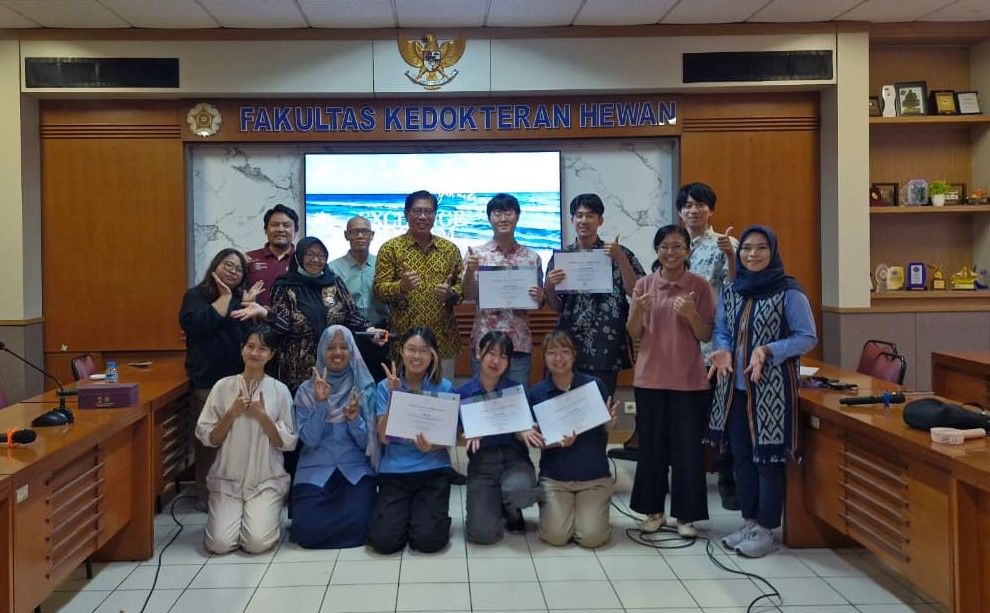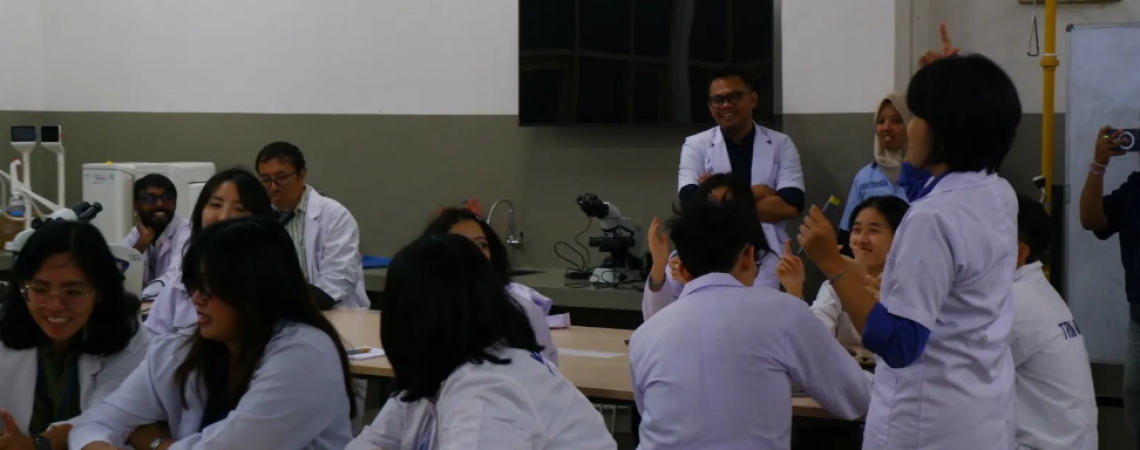
The Integrated Laboratory of the Faculty of Veterinary Medicine, Universitas Gadjah Mada (FVM UGM), served as a learning venue for “The 1st Gadjah Mada Veterinary Medicine International Summer Course 2026” on Wednesday, July 15, 2026. Centered on the theme “Guardian of Forest Wildlife: Advancing Global Perspective in Wildlife Conservation and Health,” the event provided hands-on laboratory experiences that enriched participants’ understanding of wildlife conservation, health, and welfare. The program drew enthusiastic participation from 26 individuals representing various countries, including the United Kingdom, Philippines, Taiwan, Hong Kong, Vietnam, Singapore, Brunei Darussalam, Sri Lanka, and Malaysia. Participants were divided into three small groups that rotated through three learning stations: Sperm Cryopreservation, Wildlife Parasitology, and Stem Cell Culture.
Each learning station began with an introductory session led by the supervising lecturers, followed by a practical exercise designed to provide hands-on experience in applying veterinary science to wildlife conservation. At the sperm cryopreservation station, Dr. Vincentia Yoelinda, DVM., M.Si., and Dr. Berlin Pandapotan Pardede, DVM., M.Si., guided participants through sperm viability testing techniques and provided an introduction to frozen semen preservation. Participants observed the handling of frozen semen and evaluated its quality using a microscope. This session underscored the importance of laboratory-based reproductive technologies as a wildlife conservation strategy for maintaining the sustainability of wildlife populations.
Dr. Vika Ichsania, DVM, together with a parasitology laboratory assistant, Fais, introduced the participants to wildlife parasitology. The participants examined specimens of various parasites that can affect wildlife, such as elephants, Komodo dragons, and buffalo. Through these microscopic observations, participants gained insight into the importance of detecting and controlling parasitic diseases to support animal health and the success of conservation efforts in its natural habitats. Meanwhile, at the stem cell culture station, Dr. Yudith Violetta Pamulang, DVM., M.Sc., and Dr. Irma Padeta, DVM., M.Sc., provided an introduction to basic cell culture techniques, guided the practical process of changing culture media, and facilitated the observation of stem cell growth and morphology. This session highlighted the potential of stem cell technology as an innovative approach for future biomedical research and wildlife conservation.
This interactively designed activity not only broadens participants’ understanding of the application of laboratory science in veterinary medicine but also fosters their interest in further engagement with wildlife conservation research. The event is organized under the EQUITY Program (Grant for Academic Innovation and Internationalization through Short Courses in Interdisciplinary Fields of Excellence)—an initiative of the Ministry of Higher Education, Science, and Technology (Kemdiktisaintek) and the Indonesia Endowment Fund for Education (LPDP)—facilitated by Universitas Gadjah Mada’s Directorate of Partnerships and Global Relations. This cross-border collaboration through the Summer Course aims to strengthen global perspectives and academic networks in addressing challenges related to wildlife health and welfare. Furthermore, the activity supports the achievement of the Sustainable Development Goals (SDGs), specifically SDG 3 (Good Health and Well-being), SDG 4 (Quality Education), SDG 9 (Industry, Innovation, and Infrastructure), and SDG 17 (Partnership for the goals).