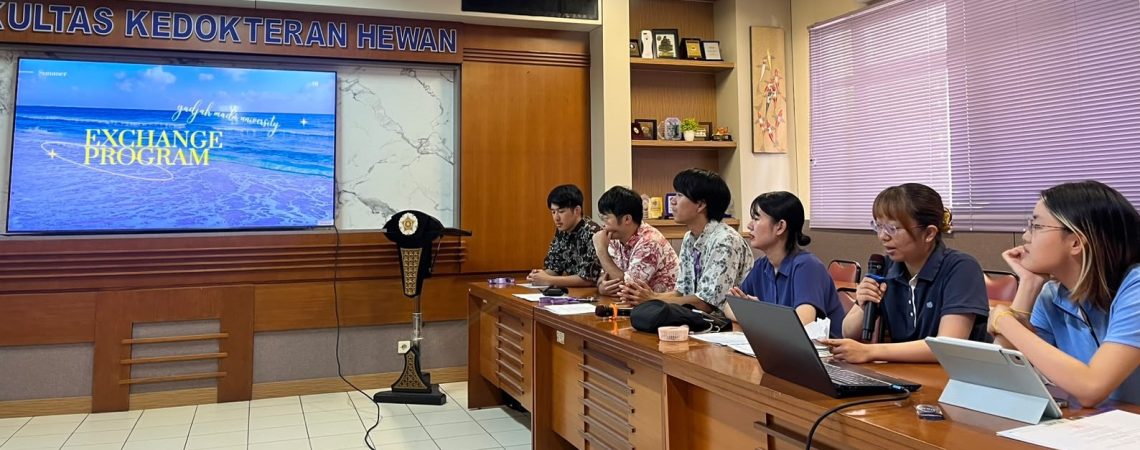
The Faculty of Veterinary Medicine at Universitas Gadjah Mada (FKH UGM) welcomed six student delegates from Yamaguchi University, Japan, for an intensive Internship Students Mobility program from September 14 to 25, 2026. This collaborative initiative aims to advance basic education and sustainability in veterinary science while strengthening international academic relationships. The delegation was formally received by FKH UGM faculty members, staff, and student representatives, kicking off a program carefully designed to provide hands-on experience in clinical practice, laboratory diagnostics, and wildlife medicine.
Throughout the two-week program, the Japanese students engaged in structured rotations across multiple departments, including Clinical Pathology, Veterinary Public Health, the Integrated Laboratory, Parasitology, and Microbiology. In these settings, they learned advanced diagnostic techniques, studied zoonotic disease surveillance, and examined microbial cultures relevant to livestock and wildlife. These activities were designed not only to enhance their technical clinical skills but also to foster a research-oriented mindset capable of addressing sustainable solutions for global disease prevention.
Beyond indoor laboratory learning, the internship integrated vital field-based activities focused on wildlife observation and conservation. The students traveled to the slopes of Mount Merapi to observe Macaca fascicularis (long-tailed macaques) in their natural habitat, gaining insights into primate behavior and human-wildlife coexistence. Additionally, they visited Suraloka Zoo and Gembira Loka Zoo to study captive wildlife management, animal welfare practices, and modern enclosure designs, which perfectly complemented their academic studies.
The timing of the visit held special significance as it coincided with major institutional milestones, specifically the 80th Dies Natalis and the 16th Lustrum of FKH UGM. The Japanese students had the unique opportunity to participate in the festive Nitilaku cultural parade and attend the 80th Dies Natalis Scientific Oration held at the FKH building auditorium. This cultural and academic integration beautifully highlighted the shared spirit of academic and civil society partnerships between the two nations.
As the internship concluded, faculty representatives from both institutions expressed strong hopes that this mobility program would serve as a long-term model for future educational collaborations, joint research, and curriculum development. Before returning, the participating students are expected to produce reflective reports summarizing their extensive learning experiences. Looking ahead, FKH UGM aims to sustain this valuable partnership to continue shaping compassionate, highly skilled veterinary professionals in both Indonesia and Japan.