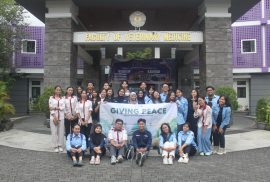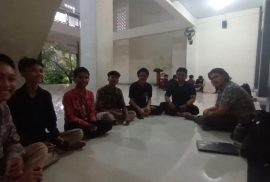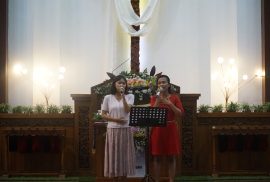
Peace is a situation that needs to be fought for and celebrated together. Based on this belief, the faculty’s religious Students’ Unit Activity (UKM) (PMK – Christian Students Fellowship, KMK – Catholic Students Family, and KMMV – Muslim Students Family) organized a Social Charity
Student Activity
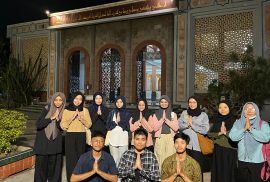
On March 19 -23, 2025, the Veterinary Muslim Student Family (KMMV) of the Faculty of Veterinary Medicine UGM held Ramadan in the Faculty (RDF) event. This activity was held offline at the An-Nahl mosque of the Faculty of Veterinary Medicine.
In Saturday, 20 April 2025 at Mini Zoo Jogja Exotarium, Sleman, Yogyakarta, Wildlife Study Group (KSSL) Faculty of Veterinary Medicine UGM held an event called Pisces or Marine Mammals Basic Medicine with the theme of Understanding the Ecology of Arapaima and Parrot Fish.
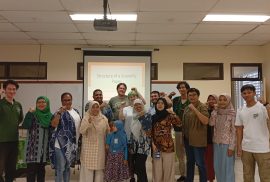
The Wildlife Study Club (KSSL), a student activity unit at the Faculty of Veterinary Medicine, Universitas Gadjah Mada (FVM UGM), organized a workshop titled “Workshop on Preparing Your Manuscript Targeting High-Impact Journals” on Saturday and Sunday, February 22–23, 2025, at Seminar Room 2, Building V4, FVH UGM.
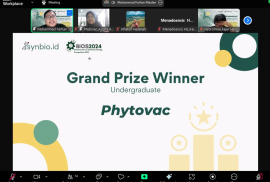
The 2024 International Genetically Engineered Machine (iGEM) competition team of Universitas Gadjah Mada (UGM) under Olimpiade Nasional Matematika dan Ilmu Pengetahuan Alam (ONMIPA) community of UGM won 5 awards in the 2024 national Bioinformatics and Synthetic Biology (BIOS) competition by Synbio.id.
Keluarga Mahasiswa Muslim Veteriner (KMMV) of the Faculty of Veterinary Medicine, Gadjah Mada University, successfully held a Leadership Training on Sunday, October 20, 2024, at the An-Nahl Mosque, FKH UGM.
ational Zoology Olympic (OZON) 2024, with “Reptile Resilience: Harnessing Adaptive Abilities in A Changing World” as the theme, was successfully held. This prestigious competition for high school students all over Indonesia attracted one hundred teams.
The mentoring sessions were conducted to revisit the basics of the Islamic faith. Several topics discussed in the mentoring sessions included aqidah (belief), including the explanation of the various aspects of tawhid (monotheism), a Muslim’s attitude towards shirk (polytheism), embracing Islam fully, belief in the Prophet Muhammad (peace be upon him), understanding the briefness of life, including matters related to the grave and the Day of Judgment, a brief fiqh (jurisprudence) on wudu (ablution) and prayer, and the manners of being a Muslim and a student.
Each meeting began with the recitation of verses from the Qur’an, with a focus on improving each student’s recitation, especially of Surah Al-Fatihah, as it is the surah that must be recited in every prayer. This was followed by the material session, which typically lasted 45-60 minutes, depending on the content of each topic, and was concluded with a Q&A session if needed.
This activity is in line with SDG 4: Quality Education, which aims to ensure inclusive, equitable, and quality education and promote lifelong learning opportunities for all. The religious guidance provided in this activity offers a foundation of education that not only covers intellectual aspects but also spiritual and moral aspects for the students. This is crucial in shaping strong character, which will be beneficial for navigating professional and social life. By introducing profound religious values, this activity helps students develop a balanced spiritual intelligence alongside their academic intelligence.
Additionally, through the division into small groups, participants are given the opportunity for more intensive discussions and personalized learning with mentors, ensuring that each student receives maximum attention in understanding the material and developing a deeper understanding of their faith. Learning in a conducive environment supports the achievement of quality education that is relevant to the needs of the times.
The Community Resources Empowerment activity also contributes to SDG 10: Reduced Inequality. The program is conducted with an inclusive approach, providing equal opportunities for all students regardless of their social and economic backgrounds. By providing equal religious guidance to all participants, this activity helps reduce the disparity in access to religious education, which is often influenced by social or economic factors.
Furthermore, by enhancing religious understanding and human values, this activity also aims to reduce social inequalities among students. During the mentoring process, students are taught the importance of mutual respect and cooperation, regardless of background, which aligns with efforts to build a more just and equitable society.
Author: Shakhra Zaha Fairuza
Photo Credit: Documentation Team of Muslim Veterinary Student Family
The mentorship program facilitated by FVM UGM aims to help the adaptation of foreign students studying in Yogyakarta, Indonesia. Each will be assisted by a mentor who is their senior. Mentors can be a learning partner, as well as be a place to ask questions about campus life and daily life in Yogyakarta. The mentors also help teaching Bahasa Indonesia to their respective mentees so that it is easier for them to blend in when studying at FVM UGM.
On the occasion of the International Students Gathering 2024, the event started with relaxing exercises by the Vice Dean for Academic and Students Affairs, namely drh. Agung Budiyanto, M.P., Ph.D. This is a warm-up activity before the mentor and mentee do field trips and fun games. Of course this increases body fitness and lightens the atmosphere.
After that, the event continued with games as a means of closer introductions among mentors, mentees, the head of study program, the secretary of study program, and the FVM UGM academic team. Participants were asked to introduce themselves, demonstrate their favorite pets and favorite subjects. This resulted in lots of laughter.
The next event was fun games, namely Capture the Flag and Nick the Balloon. This aims to strengthen solidarity, as well as exchange traditional gaming culture between students from Malaysia and students from Indonesia. After playing, a lunch session was held together. Students from Malaysia had the opportunity to taste food speciality from the coastal region of Yogyakarta, Indonesia. The event was exciting, enjoyable and useful.
The International Students Gathering supports the SDGs points, including SDG 2 No Hunger, SDG 4 Quality Education, SDG 16 Peace, Justice and Resilient Institutions.

The futsal competition was held offline at the Yogyakarta Sport Academy over two days, on October 5-6, 2024. This event was attended by 8 teams from various universities in Indonesia competing for three winning titles. The e-sports MLBB competition was held online on October 12-13, 2024, with the semifinals and finals broadcast live on the Vetcup Instagram account on October 13, 2024. Six teams from various universities were attended in this competition. (SDG 17: Partnership for the Goals).

The solo vocal competition was held online from August 20 to October 12, 2024. Participants submit their videos using the link provided in the form. These videos will be uploaded on October 13, 2024, to the Vetcup YouTube account for judging. This year, the solo vocal competition is joined by 22 participants from different universities. The winners were announced via Vetcup Instagram account on October 18, 2024.
The Veterinary UGM Cup 2024 is indirectly aligned with the Sustainable Development Goals (SDGs), specifically SDG 3 (Good Health and Wellbeing) and SDG 16 (Peace, Justice, and Strong Institutions). Vetcup 2024’s influence and impact support the goal of promoting a healthy and prosperous life, as it contributes to improving students’ health through inter-university sports competitions. Vetcup also fosters peace, justice, and strong institutions by promoting fair and peaceful competition among participants from different universities in Indonesia.
Vetcup 2024 is expected to serve as a platform for students to develop non-academic interests and talents while honing their soft skills and hard skills. It is also hoped to foster a sense of unity and sportsmanship among students. This also supports SDG point 4, namely quality education.
Cr: Afifah Firyal Rifai