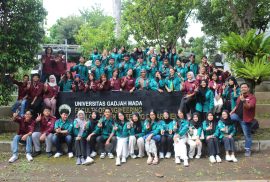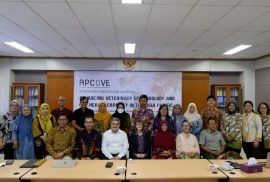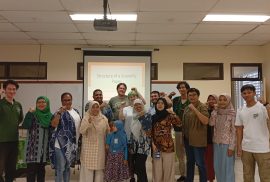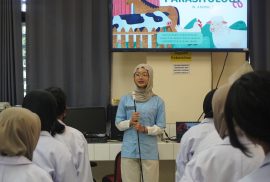
On Saturday, May 3, 2025, a Study Visit to Faculty of Engineering UGM was held at the Department of Geological Engineering UGM by the Veterinary Science Club (VSC) Network Department of Faculty of Veterinary Medicine UGM together with American Association of Petroleum Geologists (AAPG) FT UGM. The Study Visit itself is an annual work program carried out to expand the relationship of VSC members not only within the scope of the faculty but also throughout UGM area.
SDG 17: Partnership for The Goals
“Easter Special” Dog Run is a collaborative activity between the Pet Study Group (KSHK) of the Faculty of Veterinary Medicine, Universitas Gadjah Mada and the Dog Run Community located in Yogyakarta.
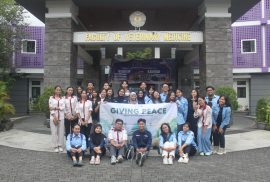
Peace is a situation that needs to be fought for and celebrated together. Based on this belief, the faculty’s religious Students’ Unit Activity (UKM) (PMK – Christian Students Fellowship, KMK – Catholic Students Family, and KMMV – Muslim Students Family) organized a Social Charity
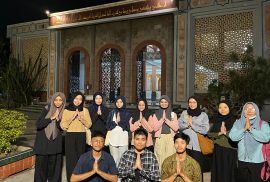
On March 19 -23, 2025, the Veterinary Muslim Student Family (KMMV) of the Faculty of Veterinary Medicine UGM held Ramadan in the Faculty (RDF) event. This activity was held offline at the An-Nahl mosque of the Faculty of Veterinary Medicine.
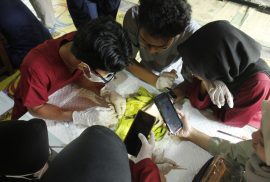
In Saturday, 20 April 2025 at Mini Zoo Jogja Exotarium, Sleman, Yogyakarta, Wildlife Study Group (KSSL) Faculty of Veterinary Medicine UGM held an event called Pisces or Marine Mammals Basic Medicine with the theme of Understanding the Ecology of Arapaima and Parrot Fish.
The Faculty of Veterinary Medicine (FKH), Universitas Gadjah Mada (UGM), is collaborating with the University of Sydney, Australia, as the lead institution in the Strengthening Veterinary Workforce in Asia-Pacific for Diseases Detection and Response (Vet-APIDDaR) project, funded by the Australian Department of Foreign Affairs and Trade (DFAT).
In this bazaar, permanent and contract education staffs, as well as outsourced workers, received affordable basic necessities containing cookies, syrup, oil, rice, eggs, wheat flour, and instant noodles. In addition, cheap basic necessities were also sold to visitors, such as oil, wheat flour, eggs, and instant noodles.
In this bazaar, there were 22 MSME booths participating. The stalls sold various food and snack products such as fried meatballs, gudeg, bakpia, as well as fashion products, skincare, and various household items such as daster, nuskin skincare, and batik clothes. Orchids are also available which are in great demand by visitors. There is also a special promo for FVM UGM’s superior product, namely Omega 3, 6, 9, DHA and EPA Eggs.
The event was also enlivened by a mini fashion show featuring hand-made ethnic clothes from Lurik Sriti Gamplong. From the head of Dharma Wanita, Mrs. Yulaeni Teguh Budipitojo, to the vice deans, lecturers, and education staff, they all did the catwalk to showcase the lurik clothes. Furthermore, the event was supported by: Januputra Farm, Farm Berkah Sawung Sejahtera, Elita Kerudung, Crystal Petlove, and Cahaya Proyektor, as well as the donors, namely the DWP FKH UGM members, the Dean and vice deans, and all of the Departments at FVM UGM.
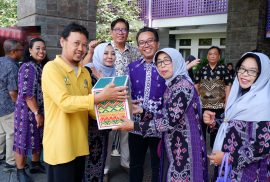
In addition to the bazaar, in order to welcome the holy month of Ramadan, DWP FVM also held social activities by visiting the Almarina Orphanage in Gunungkidul and the Ulil Albab Orphanage located in Banguntapan. The DWP FVM team provided basic necessities and clothing to these orphanages.
In addition, the DWP team also donated the homes of retired lecturers and education staff. This event aims to maintain the bond of fraternity between the extended family of FVM UGM. The existence of this activity is expected to be able to increase social awareness in the campus environment, provide benefits to others, and as moral and material support for those in need.
This bazaar and social service activity supports the values of the Sustainable Development Goals (SDGs), namely, SDG 1 No Poverty, SDG 2 Zero Hunger, SDG 10 Reduced Inequality, SDG 8 Decent Work and Economic Growth, SDG 5 Gender Equality, SDG 16 Peace, Justice, and Strong Institutions, SDG 17 Partnerships for the Goals.
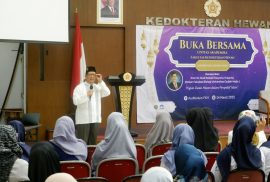
The event was attended by lecturers, education staff, and student representatives. In addition, FVM UGM also invited =&0=&to give a homily about getting to know animal world through Islamic perspective in which he explained about the creation of nature, genetics, and bioacoustics.
The event was started by a speech from the Head of the Administration Office, Triyanto S. H. He expressed his gratitude to the lecturers, education staff, and student representatives who had attended this activity and for the committee who had arranged the agenda. Furthermore, he explained that a series of activities in the month of Ramadhan 1446 H at the Faculty of Veterinary Medicine UGM including: Tadarus (reciting) Al Qur’an (30 minutes before office hours start and during break time), distributing Alms Boxes in each Department and work unit. Later on, the amount from the boxes will be distributed to Contract workers and Outsourced workers. He also said that this event began with the
The Wildlife Study Club (KSSL), a student activity unit at the Faculty of Veterinary Medicine, Universitas Gadjah Mada (FVM UGM), organized a workshop titled “Workshop on Preparing Your Manuscript Targeting High-Impact Journals” on Saturday and Sunday, February 22–23, 2025, at Seminar Room 2, Building V4, FVH UGM.
The first material was delivered by the Director General of Animal Husbandry and Animal Health (PKH) of the Indonesian Ministry of Agriculture, Dr. Agung Suganda, DVM., M.Sc. regarding the Road Map for Eradication and the Current Situation of FMD in Indonesia. The Strategic Framework for a FMD-Free Indonesia 2035 is outlined in 8 pillars, including FMD vaccination, continuous observation of FMD (surveillance), strict biosecurity and restrictions on the movement of animals susceptible to FMD, preparedness and emergency response to FMD, restoration of productivity of ruminant livestock after being affected by FMD, handling the socio-economic impact of FMD, especially for people’s livestock, and coordinating with stakeholders from within and outside the country. The Ministry of Agriculture encourages the implementation of Independent Vaccination and ensures the availability and access to good quality of FMD vaccines.
Then the second speaker, Prof. Dr. AETH Wahyuni, DVM., M.Sc., a Professor from the Department of Microbiology FVM-UGM, said that Foot and Mouth Disease (FMD) is an infectious disease that attacks cloven hoofed animals, both livestock such as cows, goats, buffalo, sheep and pigs as well as wild animals such as deer, bison, giraffes and even elephants. FMD is caused by the Foot-and-Mouth Disease Virus (FMDV) and is not a zoonotic type because this disease is not transmitted to humans. FMD itself is a serious Transboundary Disease because it is very contagious, can spread nationally and internationally quickly and unexpectedly.
The third speaker, Dr. M. Munawaroh, DVM., MM., General Chair of the Indonesian Veterinary Medical Association (IVMA), explained that handling the FMD outbreak requires a comprehensive and collaborative approach by all parties. Some of the recommendations given are the restoration of affected farms, improving the skills of veterinarians and veterinary medical officers in the field. Invest in vaccine and treatment research, carry out regular vaccinations for a minimum of 5 years.
The role of Veterinary Colleges in Handling FMD was conveyed by the fourth speaker, Prof. Agung Budiyanto, DVM., MP, Ph.D. These various roles include, forming an FMD task force team (Satgas) at the university level consisting of lecturers and students, providing clinical and laboratory experts to diagnose the virus that causes FMD, providing communication and educational information (KIE) to the community, one of which is through the annual community service programs done by students, study programs, and departments.
Next, Dr. Ir. Indyah Aryani, MM, as Head of the East Java Province Livestock Service, shared experiences and steps to control FMD in East Java since 2022. Actions taken include cage-based isolation of sick livestock, lockdown in village or sub-district-based FMD infected areas, symptomatic treatment of sick livestock, temporary closure of animal markets, restrictions on livestock traffic, disinfection of cages and the environment, conditional slaughter and mass vaccination FMD. Furthermore, Retno WIdiastuti, DVM., the sixth speaker, who is the Head of the Animal Health Division at the Animal Husbandry and Animal Health Service in Gunung Kidul Regency also explained the steps taken when FMD cases occurred. She said the steps including submitting an additional budget ahead of PERBUB Amendments to the Gunungkidul Regency’s APBD, responding to livestocks’ death reports and case tracking, sampling, burying livestock carcasses, case surveillance, cross-sectoral coordination, treatment of sick livestock in the field, disinfection of cages and the environment, giving vitamins to healthy livestocks, Communication, Information and Education (KIE), animal health checks in markets, supervision of livestock traffic, and supplies of medicines and disinfectants.
From the private livestock industry, Nanang Purus, DVM, Director of Feedlot PT. Indo Prima Beef from Lampung conveyed the impact of the huge economic losses experienced by farmers if their animals were infected with FMD. The direct impact seen is a reduction in body weight, a decrease in milk production, and even death of the animal. This direct impact has a big influence on the indirect impact because it causes an increase in costs, including slaughter costs, monitoring animal traffic and quarantine measures, additional surveillance costs and livestock vaccination costs. This also results in lost income in the form of industrial disruption and losing export opportunities. Steps taken to prevent the spread of FMD include tightening the SOP for animal traffic. Starting before the animals are departed, then entering the quarantine station, to the implementation of very strict biosecurity including biosecurity for all guests and customers, vehicle biosecurity, regular spraying of disinfectant on pens and livestock equipment, and vaccination for each cow arriving. Vaccination has been proven to be effective in preventing cows from potentially contracting FMD. Feedlot cattle that are 100% vaccinated have proven to have 0 (Zero) cases since vaccination was treated.
From the perspective of ruminant practitioners, Bima Ade Rusandi, DVM as the seventh speaker said that the condition of livestock farmers is currently still in the recovery stage since the FMD occurred in 2022. In the short term, what farmers want is accelerated treatment in outbreak areas, tightening livestock traffic and animal markets, and accelerating vaccine distribution in areas where there are still lots of healthy livestock. In the medium term, breeders want to carry out comprehensive supervision of livestock traded in the market and at the trader level. Strict monitoring of healthy animals by veterinarians. In the long term, increase human resources in the livestock sector, both as breeders and officers.
The event continued with a discussion and question and answer session moderated M.Th. Khrisdiana Putri, DVM., MP., Ph.D. From the speakers’ insight and discussion sessions, several important points that can be concluded are the need to procure vaccines according to the number of doses needed in the field (either through grant or independent schemes), optimizing the budget for handling FMD, which includes increasing the budget for vaccination, treatment, and biosecurity implementation, optimizing Communication, Information and Education (KIE) activities to the community (breeders as producers, breeders as consumers and society at large) regarding the importance of FMD, the importance of accelerating vaccination, and implementing strict biosecurity.
Apart from that, the universities need to increase the knowledge revolving FMD handling in Indonesia through collaborative research that involves more students and lecturers. Next, they need to provide a special budget for vaccinators and personal support teams in the field, and encourage the Minister of Agriculture to issue a decree stating that FMD is an epidemic so that all stakeholders can play an active role in handling FMD throughout the region.
This national seminar activity supports the values of Sustainable Development Goals (SDGs), including zero hunger, good health and well-being, quality education, responsible production and consumption, life on land, and partnerships for the goals.