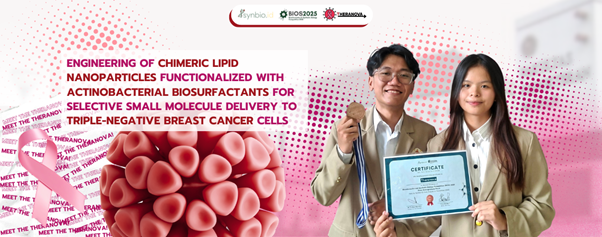
Students from the Faculty of Veterinary Medicine at Universitas Gadjah Mada (UGM) have achieved international recognition by winning a bronze medal at the Bioinformatics and Synthetic Biology Competition (BIOS) 2025. The competition was organized by synbio.id, a nonprofit organization dedicated to advancing and accelerating research in synthetic biology and bioinformatics.
In this competition, the Faculty of Veterinary Medicine UGM was represented through “Theranova,” a collaborative inter-university team comprising students from Universitas Indonesia, Universitas Brawijaya, Universitas Andalas, and Universiti Malaya, alongside UGM. The Faculty of Veterinary Medicine UGM was represented by two students, Raditia Luki Ananta and Evelyn Hartono.
Under the supervision of Prof. Dr.rer.nat. apt. Adam Hermawan, M.Sc., Professor at the Faculty of Pharmacy UGM, the team presented their research entitled “Engineering of Chimeric Lipid Nanoparticles Functionalized with Di-Rhamnolipid for Selective Delivery of PGV-1 in Triple Negative Breast Cancer Cells.” This research focused on developing a drug delivery system based on chimeric lipid nanoparticle modeling. The key innovation lies in utilizing the biosurfactant di-rhamnolipid to enhance the selectivity and delivery efficiency of PGV-1, a promising small-molecule anticancer candidate, specifically targeting Triple Negative Breast Cancer (TNBC) cells. The chimeric lipid nanoparticle was engineered by integrating di-rhamnolipid to enable specific targeting of TNBC cells, which are known for their aggressive nature and lack of conventional therapeutic targets. This approach is expected to improve therapeutic precision while minimizing systemic side effects.
The BIOS 2025 competition was conducted through a rigorous selection process from August to November 2025. The stages included abstract submission, development of a project website as a research showcase platform, and fulfillment of defined project deliverables. In the final round, the Theranova Team presented their innovation before a panel of judges. Their strong conceptual framework, in-depth bioinformatics analysis, and robust methodological design were key factors contributing to their success in securing the bronze medal.
Raditia Luki Ananta, team leader of Theranova, stated, “We plan to continue this research in collaboration with Prof. Adam Hermawan and also with Badan Riset dan Inovasi Nasional (BRIN) to develop a prototype ready for preclinical testing.” Evelyn Hartono added, “This collaboration with BRIN represents a strategic step to accelerate the translation of laboratory research into real clinical applications, particularly for TNBC therapy.” These statements reflect the team’s commitment to advancing impactful and translational scientific innovation.
This achievement represents a tangible contribution by academic communities in supporting the global Sustainable Development Goals (SDGs) established by the United Nations, particularly SDG 3 (Good Health and Well-Being), SDG 4 (Quality Education), and SDG 17 (Partnerships for the Goals). Through innovation in TNBC therapy, this research aims to provide safer and more effective therapeutic solutions for breast cancer patients and contribute to reducing mortality from non-communicable diseases through advances in pharmaceutical technology (SDG 3). Furthermore, this accomplishment reflects the quality of higher education that integrates research-based learning and innovation. Participation in international competitions enables students to apply theoretical knowledge in practical contexts, particularly in advanced bioinformatics and molecular biology (SDG 4). In addition, multidisciplinary collaboration across institutions, including UGM, UI, UB, Universitas Andalas, and Universiti Malaya, along with active mentorship from academic supervisors, demonstrates strong institutional synergy and serves as an example of strategic partnerships in generating innovations with broad societal impact (SDG 17).